
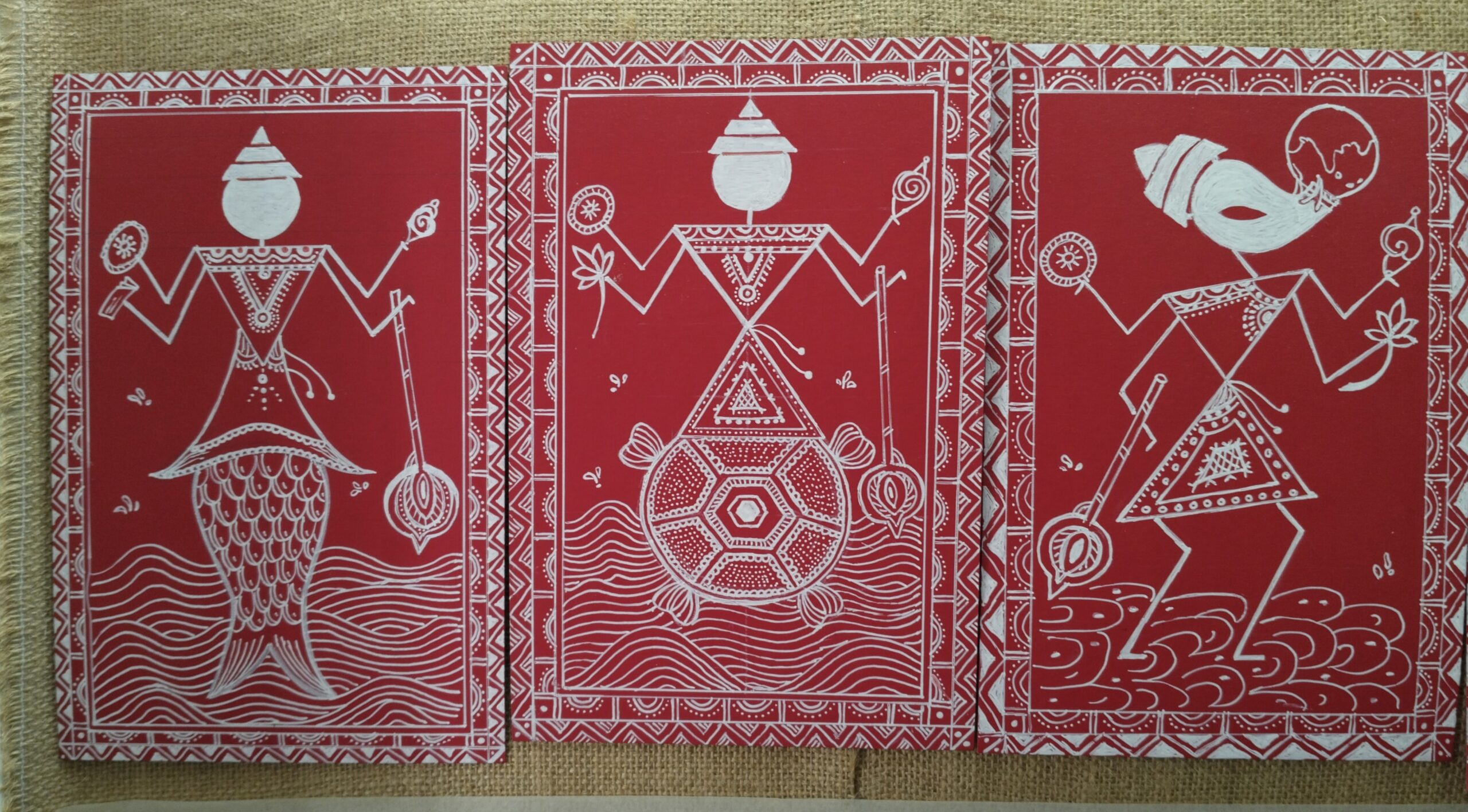
The Warli Dashavatar Series That Found a Beautiful Home on My Wall
My Warli Dashavatar series is one of the artworks that quietly become part of my life.
Not because it is perfect, or because it was planned to be displayed forever, but because it carries a story that we, as a family never want to pack away.
Why Warli?
It all began with the very first collaborative art project I joined with a group of artist friends. The theme was Dashavatar, the ten incarnations of Lord Vishnu. While each of us interpreted the theme in our own style, I decided to explore it through Warli art. I had always admired the simplicity of Warli art. With just a few lines, artists could create entire worlds filled with people, animals, celebrations and stories. That simplicity attracted me, even though I knew it would take patience to achieve.
Around the same time, I also created a Pattachitra Dashavatar series, but it was the Warli collection that I found challenging.
I had always admired the simplicity of Warli art. With just a few lines, artists could create entire worlds filled with people, animals, celebrations and stories. That simplicity attracted me, even though I knew it would take patience to achieve.
Like many collaborative projects, this one unfolded one artwork at a time. I began with Vamana, carefully getting used to the simple lines and balanced compositions that Warli art is known for. As I grew more comfortable, I found myself looking forward to each new avatar.
Some became favourites almost instantly.
As each avatar took shape, I found myself looking forward to the next sheet of red paper. Matsya let me play with flowing waves, Kurma gave me the joy of creating movement in water, and Narasimha bursting through a pillar became one of the most dramatic compositions in the series. By the time I reached Rama and the graceful figure of Krishna, I realised I was no longer worrying about drawing in the Warli style; I was simply enjoying the process.
How the series came into my drawing room
When the collaboration ended, the paintings were carefully tucked away inside a file folder. That was where I imagined they would stay.
Months later, while arranging our Navaratri Golu, I took them out again. I wanted them to be part of the festive display, and as I looked at the ten paintings together, I realised they deserved to be seen more often.
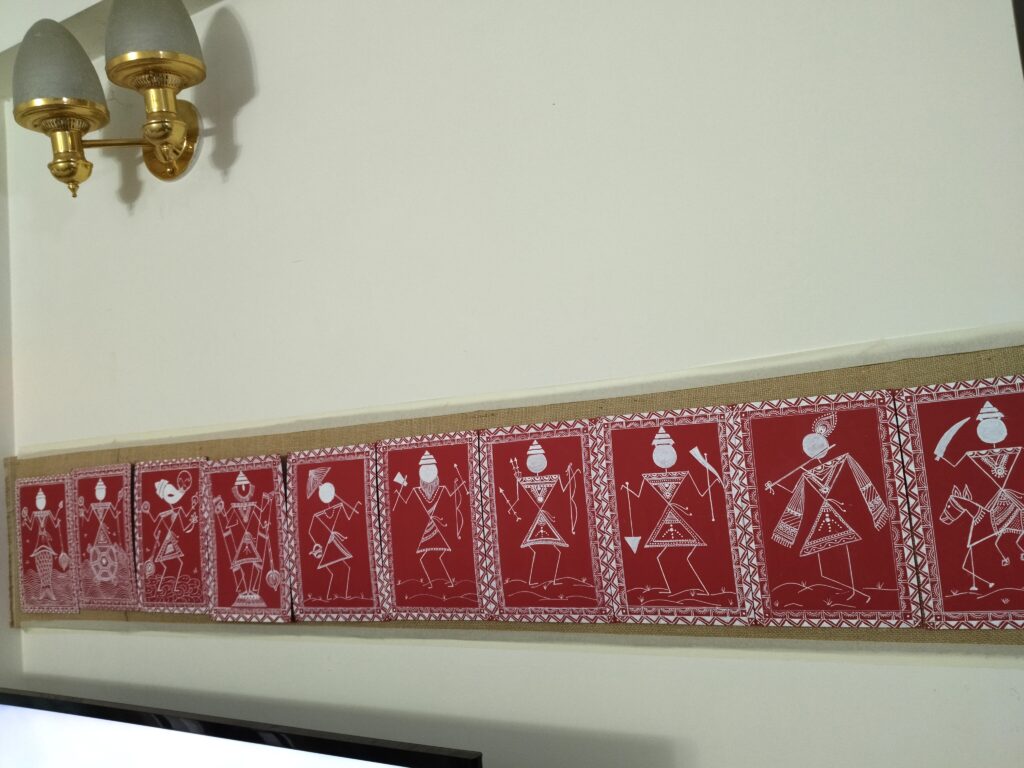
I wasn’t looking for an expensive frame or a polished gallery display. Instead, I chose something wonderfully simple – a strip of natural jute fabric. Using painter’s tape, I arranged each artwork in a long horizontal line. The earthy texture of the jute seemed to complement the simplicity of Warli art perfectly, almost as if they had always belonged together.
Today, the entire series hangs in my drawing room.
All of this Dashavatar Series as a single image on my Pinterest Page
Every morning, as I walk past them, the white figures against the deep red background quietly catch my eye. Together, they remind me not only of the Dashavatar, but also of friendship, shared creativity, and the confidence that came from trying something new.
Somehow, seeing these ten avatars together on the wall gives me a quiet sense of divine protection.
Visitors often pause to look at them. Some ask about Warli art. Others try to identify each avatar. Those conversations always make me smile, because the paintings continue to do exactly what folk art has always done – bring people together through stories.
Sometimes we create an artwork simply because we enjoy the process. Sometimes, without planning it, that artwork slowly becomes part of our everyday life.
This series has become exactly that for me.
I will be uploading a FREE PRINTABLE SHEET of this artwork soon. Until then, you may check the other FREE Printables on this page – https://revarttales.com/free-printables/
Materials I Used for this Artwork
Many ask me what I use for my folk-art drawings. These are the simple materials behind this Warli Dashavatar series.
- White gel pen
- Red cardstock paper
- Natural jute fabric for display
- Painter’s tape for mounting
(If you are curious, I have listed the art materials I regularly use on my My Art Desk page. RevArtTales.com is a part of the Amazon Associates program. If you buy through these links, I earn a small commission at NO EXTRA COST to you. I only share tools I actually use on my art desk. Thank you for supporting my art journey.)
2 Comments